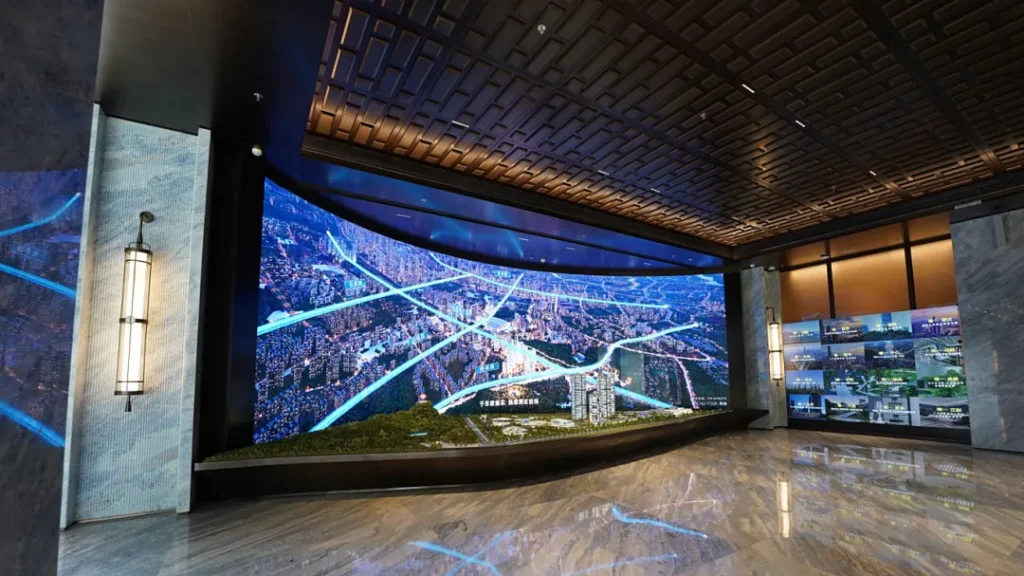

There’s a moment in the Weimei Ceramics Museum where you stop and stare at what looks like a traditional Chinese ink painting hanging on the wall. Mountains in the distance, a winding stream, rich greens and earthy tones rendered with the kind of detail that makes you lean in closer. And then it moves.
What you thought was a painting is a screen. And that’s exactly the point.
The Problem With Screens
Walk into almost any modern commercial space and you’ll find screens everywhere — in lobbies, showrooms, retail stores, museums. Most of them look exactly like what they are: rectangular slabs of glass mounted on a wall, broadcasting content at you whether you want it or not.
They work. But they don’t belong.
There’s always a tension between a screen and the space it sits in. Architects and interior designers spend months getting every material, texture, and light source right — and then someone bolts a commercial display to the wall that immediately draws all the attention, kills the atmosphere, and looks completely out of place the moment it’s switched off.
This is the problem that COB Art Screen technology is designed to solve.
What Is COB Technology?
Before we get into the art side of things, it helps to understand what makes COB displays different from conventional LED screens.
COB stands for Chip-on-Board. In traditional LED displays, individual LED components are mounted onto a circuit board with exposed solder points, protective coatings, and visible gaps between pixels. The result is a display that looks great from a distance but reveals its mechanical nature up close — you can see the grid, the structure, the fact that it’s a screen.
COB packaging flips this around. The LED chips are embedded directly into the board surface and covered with a smooth, uniform protective layer. The result:
- No visible pixel structure up close — the surface looks and feels more like a material than a device
- Higher durability — the protective layer resists dust, moisture, and physical contact
- Better contrast — deeper blacks because there’s no reflective gap between pixels
- Finer pixel pitch — COB enables pitches like P1.2 (1.2mm between pixels) that are extremely difficult to achieve with traditional packaging
At P1.2 pitch, you’re looking at roughly 694,000 pixels per square metre. That’s the kind of density where, standing at a normal viewing distance, the human eye simply cannot resolve individual pixels. It just looks like an image.
The Weimei Ceramics Museum Installation
Zhongqi Optoelectronics brought this technology into the Weimei Ceramics Museum as part of a collaboration with Marco Polo — one of China’s most recognised premium ceramic tile brands.
The brief wasn’t “install a display.” It was closer to: create something that belongs here.
The solution was a full-screen P1.2 COB display with a custom-printed landscape based on the traditional Chinese painting “Flowing Water Brings Wealth” a classical ink painting motif of mountains, streams, and flowing water that carries deep cultural meaning in Chinese interior design.
The result is a display that operates in two distinct modes:
When switched off: It reads as a large-format artwork. The fine-pitch COB surface, combined with the custom landscape image, makes it visually indistinguishable from a high-quality art print or textile wall covering. Visitors to the ceramics museum see a piece that fits naturally within the aesthetic — traditional, considered, crafted.
When switched on: It becomes a fully functional digital display capable of brand content, product storytelling, interactive scenarios, and dynamic visual experiences. The same surface that was a painting a moment ago is now a high-resolution digital canvas.
This dual identity — static artwork and active display — is what makes the Art Screen concept genuinely interesting.
Why This Matters for Spatial Design
Interior designers and architects have always struggled with screens. The standard options are:
- Hide the screen — recess it into a wall, put it behind a panel, design around its absence
- Make it a feature — lean into the technology, make the screen obviously a screen
- Ignore the problem — mount a commercial display and hope it doesn’t ruin everything
COB Art Screen technology offers a fourth option: make the screen belong.
When a display surface can credibly pass as a decorative element in its off state, the designer’s problem disappears. The screen doesn’t compete with the space — it becomes part of it. And when content is needed, it’s there.
This opens up applications that simply weren’t viable before:
- Luxury retail — brand flagship stores where the visual environment is everything
- Hospitality — hotel lobbies, restaurant feature walls, spa environments
- Museums and galleries — spaces that need digital information without the clinical feel of a mounted monitor
- Houses of worship — where the atmosphere demands that technology be invisible
- Corporate headquarters — reception areas and boardrooms where first impressions matter
- High-end residential — increasingly, discerning clients want screens that don’t look like screens
The Cross-Industry Collaboration Model
One of the more interesting aspects of the Weimei project is what it says about how display technology is being positioned.
Zhongqi Optoelectronics partnering with Marco Polo — a ceramics brand — isn’t an obvious combination. But it’s a deliberate one. By associating COB display technology with a brand known for material quality, craftsmanship, and design sophistication, the message to the market is clear: this isn’t a commercial AV product. This is a design material.
This framing matters enormously for how the technology gets specified and sold. When an architect or interior designer sees a display product endorsed by a ceramics brand in a museum context, they think about it differently than when they see a spec sheet in an AV catalogue.
It’s a positioning move as much as a product showcase.
The Technical Reality
For anyone specifying or evaluating this technology, here’s what the P1.2 COB Art Screen actually delivers:
| Specification | Detail |
|---|---|
| Pixel Pitch | P1.2 (1.2mm) |
| Technology | COB (Chip-on-Board) |
| Surface | Smooth, seamless, grain-free |
| Viewing Distance | Grain-free from approximately 1.5m+ |
| Appearance (Off) | Custom artwork / decorative panel |
| Appearance (On) | High-resolution digital display |
| Applications | Museums, luxury retail, hospitality, corporate |
The seamless design means no visible bezels or joins across the display surface — critical for the artwork illusion to work. At P1.2 pitch, the display reads as a continuous image rather than a grid of pixels.
What This Tells Us About Where Display Technology Is Going
The Weimei Ceramics Museum installation is a small project. One screen, one museum, one collaboration. But it points toward something significant.
Display technology has spent decades getting better at being a screen — brighter, sharper, thinner, cheaper. COB Art Screen technology represents a different ambition: getting better at not being a screen.
As pixel pitches continue to decrease and COB manufacturing improves, the visual gap between a high-quality display and a printed artwork will narrow further. Displays will become thinner, lighter, and more capable of mimicking any surface texture or material.
The question for designers, specifiers, and brands is no longer just “where do we put the screen?” It’s becoming: “what do we want this surface to do?”
A screen can be a wall. A wall can be a screen. And somewhere in between, there’s a space for something that’s genuinely both.
Summary
- COB technology produces fine-pitch LED displays with a smooth, seamless surface that reads as a material rather than a device
- P1.2 pitch delivers ~694,000 pixels per square metre — effectively grain-free at normal viewing distances
- Art Screen concept = dual-state display: artwork when off, digital display when on
- The Weimei installation used a custom “Flowing Water Brings Wealth” landscape across the full screen surface
- Market opportunity is in spaces where the visual environment is a priority: luxury retail, hospitality, museums, high-end corporate
- The broader trend is display technology moving from functional device toward architectural material