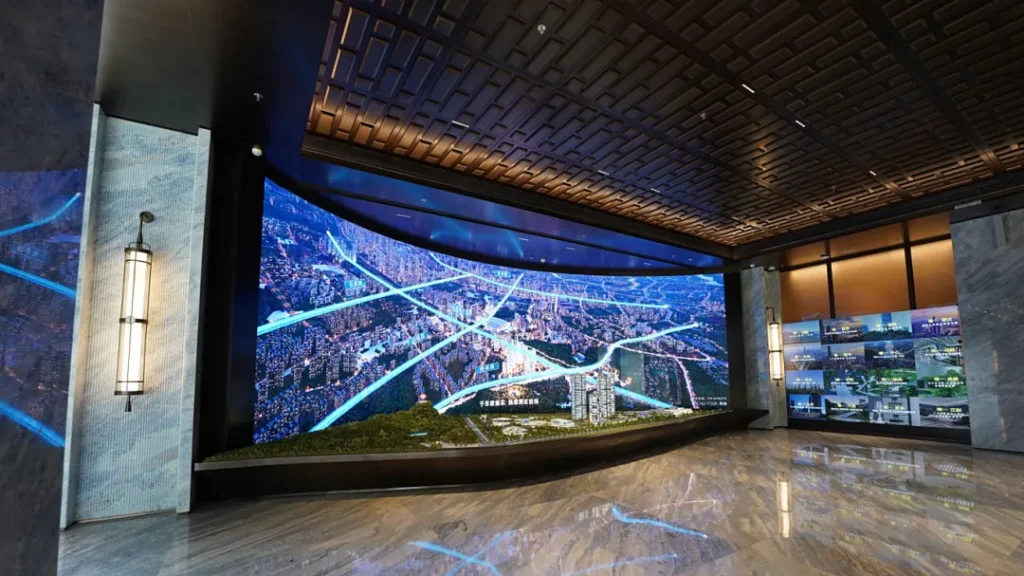
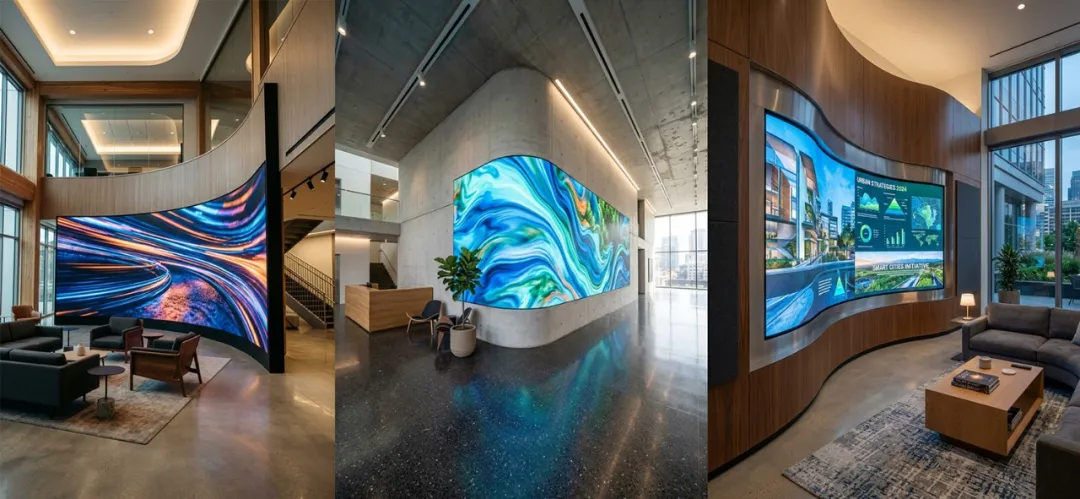
As commercial environments become increasingly immersive, digital displays are evolving from simple information delivery tools into essential components of spatial design.
Today, architects, designers, and system integrators are expected to create experiences that blur the boundaries between technology, architecture, and storytelling. From luxury retail environments and commercial complexes to museums, exhibition halls, and digital art installations, LED displays are no longer confined to flat walls. They are becoming part of the physical structure itself.
This shift is driving demand for curved displays, cylindrical screens, wave-shaped installations, and other unconventional display formats. However, despite advances in LED technology, one major challenge has remained: achieving both creative freedom and premium image quality in a single solution.
The Traditional Compromise in Flexible LED Displays
For years, designers have faced a difficult decision when developing irregular-shaped LED installations.
Traditional flexible LED displays offer the structural adaptability needed to create unique forms, but they often rely on SMD technology with larger pixel pitches. While suitable for long-distance viewing, these displays can exhibit visible pixelation and reduced image clarity when viewed up close.
On the other hand, fine-pitch LED displays deliver exceptional visual performance but typically use rigid modules. To create curved structures, these modules must be assembled into segmented polygonal shapes that approximate a curve rather than forming a truly smooth surface.
The result is a compromise between aesthetics and visual quality—one that can limit the impact of an otherwise innovative design.
Why the Industry Needs a New Approach
As display technology becomes more integrated into architectural spaces, the expectations of end users continue to rise.
Modern audiences expect:
- Seamless visual experiences
- High-definition image quality
- Immersive environments
- Unique architectural integration
- Reliable long-term performance
Meeting these expectations requires more than incremental improvements in brightness or resolution. It requires a fundamental rethinking of how LED displays are designed and manufactured.
The next generation of display solutions must support creative structures without sacrificing image quality.
Introducing a New Era of Flexible Fine-Pitch Displays
This is where the combination of flexible substrates and COB (Chip-on-Board) technology is changing the industry.
By directly bonding LED chips onto a flexible substrate, COB technology enables finer pixel pitches, improved contrast, greater color consistency, and a more uniform display surface than traditional flexible SMD solutions.
The result is a display that can conform to complex architectural forms while maintaining the image quality typically associated with premium fine-pitch LED systems.
For designers and system integrators, this represents a significant advancement. Creative concepts no longer need to be simplified to accommodate display limitations. Instead, the display can adapt to the design vision.
Engineering Designed for Creative Spaces
Beyond image quality, modern flexible display solutions must also address the practical realities of installation and maintenance.
Advanced flexible LED systems now support a variety of applications, including:
- Cylindrical columns
- Curved feature walls
- Wave-shaped digital sculptures
- Convex and concave surfaces
- Custom architectural installations
Precision engineering ensures smooth transitions, seamless alignment, and improved structural integrity, creating displays that appear as a natural extension of the space rather than a separate technological element.
Standardized module dimensions and compatibility with conventional LED systems further simplify deployment, helping reduce installation complexity and project costs.
The Evolution from Display Technology to Spatial Technology
Perhaps the most significant change occurring in the industry is conceptual rather than technical.
LED displays are no longer simply screens mounted within a space. Increasingly, they are becoming part of the space itself.
Architects and designers are using display technology as a building material—one capable of shaping atmosphere, guiding visitor experiences, and transforming environments in real time.
As this trend continues, solutions that combine flexibility, precision, and premium image quality will become increasingly important.
Looking Ahead
The future of commercial display technology lies in seamless integration between digital content and physical environments.
By eliminating the traditional trade-off between flexibility and fine-pitch performance, next-generation display technologies are opening new possibilities for creative expression and immersive experiences.
For businesses seeking to create memorable environments, the question is no longer whether displays should be part of the design. The question is how seamlessly they can become part of the architecture itself.
As the industry moves forward, flexible fine-pitch LED displays will play a key role in defining the next generation of commercial, cultural, and experiential spaces.