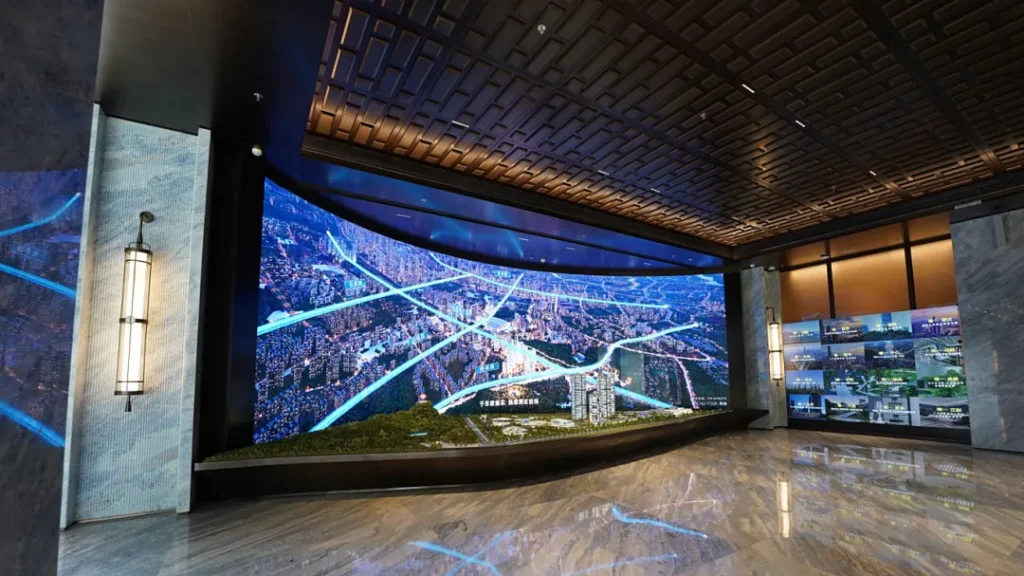

Stone has weight. Wood has warmth. Now LED has texture — and it’s changing how designers think about screens.
There’s an old problem in interior design that nobody talks about openly.
You spend months getting a space right. Every surface chosen deliberately — the stone, the timber, the finish on the metalwork. The light bouncing off each material exactly as intended. And then the client asks for a screen.
The moment a conventional display goes up, something changes. When it’s on, it dominates. When it’s off, it’s a large black void on a wall that someone worked hard to make beautiful. It doesn’t belong to the space. It tolerates the space.
COB art screen technology is ending that compromise.
What Materials Actually Do
Before talking about screens, it’s worth thinking about what decorative materials actually do in a space.
Stone conveys weight and permanence. Timber brings warmth and organic character. Metal reads as precision and modernity. These aren’t just aesthetic choices — they’re communicative ones. Every surface in a designed space is saying something, contributing to the overall character of the environment.
Traditional displays opt out of this conversation entirely. They’re neutral when on and actively disruptive when off. They exist in a space without contributing to it.
The insight behind COB art screens is simple but significant: what if a display could participate in the space the same way a material does?
The Dual-State Display
Art screens achieve this through a combination of two technologies working together — COB display engineering and surface texture coating.
The COB (Chip-on-Board) foundation provides a seamless, fine-pitch display surface with no visible pixel grid at normal viewing distances. On top of that, Zhongqi’s patented surface treatment technology applies a physical texture finish — marble veining, wood grain, custom imagery — that is visible and convincing in the off state.
The result is a surface that genuinely exists in two states:
Off: A decorative wall panel. The texture finish reads as a material — not a screen pretending to be a material, but a surface that belongs to the space on its own terms. Visitors see marble. They see timber. They see art. They don’t see a screen.
On: A high-definition, seamless LED display delivering smooth digital content at full broadcast quality. The same surface that was architectural a moment ago is now a communication medium.
No black void. No disrupted visual order. Just a wall that has more capability than it appears to.
Durable Enough to Be a Material
Looking like a decorative material is one thing. Performing like one is another.
Zhongqi’s COB art screen surface is engineered to meet the durability standards of genuine building materials — not the maintenance standards of a display product:
- IP65 waterproof and dustproof — sealed against moisture and environmental particulates
- IK09 impact resistance — withstands significant physical contact without surface damage
- Wear and stain resistant — handles the daily contact that any wall surface faces
- Alcohol-wipeable — cleaned with standard products, the same way you’d clean ceramic tile or a glass splashback
That last point is more important than it sounds. In hotels, museums, and commercial spaces, maintenance teams use standard cleaning routines. A display that requires specialist care creates operational friction. A display that cleans like a wall disappears into normal building maintenance — which is exactly where it should be.
Seeing Is Believing — The Sample Box
Zhongqi has launched a physical art screen sample display box specifically to address the challenge of communicating this technology without a live demonstration.
The sample box showcases multiple texture finishes — including marble and wood grain variants — and allows customers to experience the switch between off-state decoration and on-state display in real time, in person.
This matters because photographs don’t capture it. The transition from a convincing marble finish to a high-resolution digital display is something that needs to be seen live to be fully understood. The sample box brings that experience to the specification and sales conversation.
A New Arena for the Display Industry
There’s a line from Zhongqi worth sitting with: “As screens begin to integrate into spaces, a new arena is opening up for the display industry.”
That arena is the world of architecture and interior design — a world that has historically kept display products at arm’s length, treating them as necessary intrusions rather than design elements.
Art screen technology is the first genuine answer to that resistance. When a display can be specified the same way a designer specifies a material — chosen for how it looks, how it feels, how it contributes to the space — the conversation changes entirely.
Architects and interior designers stop asking “where do we put the screen so it doesn’t ruin everything?” and start asking “what do we want this surface to do?”
That shift — from device placement to material specification — is what makes COB art screen technology significant. It’s not just a better display. It’s a display that belongs.
Who Should Be Paying Attention
This technology isn’t for every environment. It’s for spaces where the quality of the interior is part of the value proposition:
- Luxury hotels and hospitality — where atmosphere is the product
- Brand flagship stores — where the environment communicates the brand
- Corporate headquarters — where reception and boardroom spaces make first impressions
- Museums and cultural spaces — where digital capability can’t come at the cost of the environment
- Houses of worship — where technology must serve the atmosphere, not compete with it
- High-end residential — where clients want capability without the visual intrusion of a screen
In all of these environments, the standard answer to “we need a display” has always involved some degree of compromise. COB art screen technology removes that compromise.
The Takeaway
Display technology spent decades optimising for one thing: being a better screen. Brighter, sharper, thinner, more reliable.
COB art screen technology optimises for something different: being a better wall.
And in the spaces where design matters most, that’s a far more valuable thing to be.